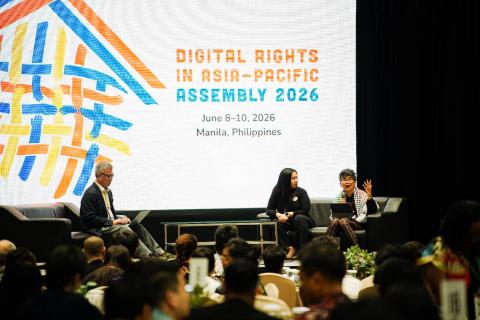
Last year brought severe challenges for civil society, which continues to grapple with the aftershocks of sweeping funding cuts and debilitating constraints. Thousands of jobs vanished overnight. Many human rights defenders (HRDs) lost vital support systems, and several organisations were forced to shut down or scale back their work. This mounted pressures on already shrinking civic spaces and jeopardised digital rights even more. However, alongside the crisis emerged a profound sense of resilience, as organisations found new ways to sustain their work, strengthen collective action and empower communities.
This shared resilience was evident at the fourth edition of the Digital Rights Asia-Pacific Assembly (DRAPAC) held in June 2026 in Manila, the Philippines capital. The event brought together HRDs, digital rights practitioners, journalists, academics, strategic thinkers, technologists and students from across the region. Co-hosted by EngageMedia, the Foundation for Media Alternatives, and DAKILA – Philippine Collective for Modern Heroism, DRAPAC26 featured 60 sessions, exhibitions and a range of activities under the theme, “Resilient Digital Futures: Co-creating Collective Resources Across Movements”.
Taking forward our initiative to engage with members of the Association for Progressive Communications (APC) in the region at DRAPAC, we invited them to share deeper insights into their advocacy work. This year, our engagement was shaped by the cancellation of RightsCon 2026 just a month before DRAPAC, which exposed the fragility of civic spaces and how external pressures can affect them. Through our conversations, we sought to understand the strategies that our members are deploying to resist threats to civic spaces and to identify areas where urgent collective action is needed to defend digital rights in the Asia-Pacific region.
Strategies rooted in community engagement, digital empowerment, and sustainability remain integral across the advocacy spectrum. Here is how our members in India, the Philippines, Myanmar, Indonesia, Nepal, Bangladesh and Taiwan are making concerted efforts to keep civic spaces open, accessible and secure.
Keeping civic spaces open, accessible, and secure
Servelots, which is working to platform individuals with low literacy online in India, has adopted a creative way to mobilise women from conservative households. “We have a crafts centre,” shares T. B. Dinesh. He explaines that the centre serves as an “attraction” and gives women a socially acceptable reason to meet and communicate as they sadly are often “monitored” and not allowed outside their homes otherwise.
The Digital Empowerment Foundation (DEF), meanwhile, is focusing on developing self-sustaining, community-led digital inclusion models in India such as SoochnaPreneur and Samriddh Gram. “Through these models, local community members become social entrepreneurs who help others access government services, information and digital tools while earning a livelihood from this work,” DEF’s Maitri Singh explains.
SFLC.in is responding to shrinking civic spaces through legal, research and policy interventions; monitoring of digital rights cases, including technology-faciliated, gender-based violence (TFGBV); documentation of free speech violations; capacity building; and community empowerment. “Through these initiatives we work to address key issues, including, but not limited to, responsible AI, TFGBV, internet shutdowns, surveillance and privacy, search and seizure of devices and content takedown [and] free speech,” according to Greeshma Chauhan.
In the Philippines, women human rights defenders (WHRDs) are routinely targeted for their work. These threats force them to modify their advocacy strategies as a means of self-protection. “Sometimes, what they do is tone down their messages,” observes Lisa Garcia from the Foundation for Media Alternatives (FMA). FMA is educating WHRDs on digital hygiene, online safety, and protective technologies and applications. The FMA is also currently documenting TFGBV, with a scope that goes beyond the Philippines. The research is aimed at developing a deeper understanding of TFGBV by grounding its analysis in regional perspectives. A majority of the material on TFGBV comes from the west, which leads locals to believe that not much on the issue is being done in the country, according to Lisa.
The Philippines-based organisation Institute for Social Entrepreneurship in Asia (ISEA), on the other hand, has centred its work on maximising productivity through connectivity. “We believe that the right to meaningful connectivity is actually a right that is not given enough attention,” ISEA’s Lisa Dacanay says. Lisa believes that advocacy around connectivity can be advanced alongside the right to development and facilitate people’s access to digital opportunities.
Similarly, in Indonesia, Tisha Amelia from Common Room views community ownership and collective action as an important form of resistance to shrinking civic spaces.
“By creating local spaces where people can learn, organise and work together, communities are finding their own ways to strengthen resilience, protect their rights and shape a more inclusive digital future,” Tisha says, adding that meaningful connectivity also involves equipping people with the knowledge, confidence and opportunities needed to use technology that can benefit them in everyday life.
While Myanmar is facing a severe crackdown on internet access, arbitrary arrests of online dissenters and digital censorship, civil society organisations (CSOs) have been facing chronic understaffing, heavy taxation, funding scarcity and threats from multiple fronts. Yet they remain undeterred and become only more resilient. “For prevention, we provide digital security training, technical support, and individual and organisational security assessments to help communities better protect themselves,” Ash from SRS and the Myanmar Internet Project (MIP) elaborates. “Sometimes the impact feels slow, but over time it becomes visible,” reflects Ash, adding: “In Myanmar, especially since 2021, we have seen a significant increase in awareness and adoption of safer digital practices.”
Nuva Rai, who works with Body & Data, shares a reflection from Nepal. “We recognise that patriarchal and state surveillance thrives on isolating activists, which is why we intentionally curate spaces to mend the fractures within our feminist ecosystems,” Nuva explains. The organisation hosts “Chiya Charcha” (Tea Talk), a monthly feminist series bringing conversations on digital rights, disability justice, queer organising and feminist activism to deepen collaboration, share expertise and create collective defence mechanisms.
In Bangladesh, Voices for Interactive Choice and Empowerment (VOICE) is prioritising support and collaboration through strategic partnerships amid financial challenges. “Knowledge and resources-sharing also help us to navigate in this regard specifically as the sector is undergoing substantial funding constraints,” VOICE’s Musharrat Mahera notes.
The role of civil society: Protecting digital rights through support to those on the ground
One point emerging from many members is that civil society continues to play a crucial role in supporting local communities and defending digital rights. Across the region, networks of activists, researchers and organisations are building knowledge repositories and support systems for people with limited access to resources or even connectivity, frequently stepping in where state institutions fail them.
Common Room’s School of Community Networks (SCN) is facilitating communities in rural and underserved areas to learn building and managing their own connectivity initiatives. Through the programme, communities explore how technology can support education, local businesses, climate resilience and disaster preparedness. “We’ve seen people become more confident, more connected and more involved in decisions that affect their communities,” Tisha observes.
The DEF has invested in the Digital Citizen Summit and Community Network Xchange as platforms that bring together CSOs, community leaders, policy makers and researchers. “These spaces help surface local experiences, share strategies and strengthen movements working on digital rights and community-led connectivity in India and the Asia-Pacific region,” says Maitri of DEF.
SFLC.in’s RightsLine, a 24/7 helpline, has also become an important resource for people facing digital rights violations. It offers legal and technical assistance on issues ranging from online harassment and privacy breaches to cyber fraud and wrongful content takedowns. Through RightsLine and the Digital Security Training programme, which has reached more than 14 states and over 12,000 people in India, the organisation seeks to equip individuals with practical skills to navigate the digital landscape as it turns complex. “This is precisely the gap that civil society like ours is positioned to fill,” Greeshma highlights.
In Myanmar, MIP monitors internet shutdowns, digital censorship, and arbitrary arrests of individuals expressing dissent online, sharing its findings with international organisations and the media so violations do not disappear into silence. “It conducts research and studies on the oppression, documents it, and publishes reports,” according to Nyan, also from MIP. “It sends them to relevant international organisations.” However, Ash acknowledges that the lack of rule of law and increasing digital repression keep posing challenges. “This is why civil society efforts remain essential, and stronger platform accountability and advocacy are needed to better protect users and their rights,” Ash stresses.
The Feminist Leadership and Mobilization on the Edge (FLAME) points out the importance of civil society in Taiwan to frame online gender-based violence as a structural challenge shaped by social inequality, platform governance and unequal access to technology and justice. “By supporting survivors, raising public awareness, advocating for legal reform and engaging in dialogue with government agencies, civil society helped shift the public conversation from one centred on individual privacy violations to one that recognises image-based sexual abuse as a broader issue of gender-based violence and human rights,” summarises FLAME’s Kuan-jung.
These collective efforts also contributed to important legal reforms in Taiwan, including stronger protections against the non-consensual distribution of intimate images, expanded accountability for perpetrators and improved support mechanisms for survivors, according to them.
The initiatives vary in design and scope, but they point to a shared lesson. Protecting digital rights is not solely a matter of policy reform; it depends on communities creating their own forms of support, solidarity and collective care.
Confronting exclusionary technologies, algorithmic impunity and AI harms
The deployment of artificial intelligence (AI), biometric technologies and digital public infrastructure without adequate safeguards and meaningful expert consultation is among the emerging challenges for rights advocates and organisations. These technologies are being presented as “neutral” solutions even when they deepen inequalities and create new forms of exclusion, as well as having a significant socio-environmental impact.
Nuva of Body & Data points to the aggressive push towards biometric identity systems and digital-first welfare mechanisms, arguing that such initiatives often reproduce exclusion for already marginalised communities.
“We must collectively demand a ‘right to refusal’ when technology replicates colonial, patriarchal or caste-based exclusion,” Nuva urges.
Common Room’s Gustaff Iskandar calls for “public-first guardrails” around emerging technologies, greater transparency in content moderation and algorithms and stronger protections for marginalised communities. “We also need to look at open-source technology, developing community-governed data commons and secure digital repositories that cannot be seized or shut down by single entities,” Gustaff asserts. Greeshma, on the other hand, stresses the need for secure digital spaces, especially for the LGBTQIA+ community. “Collective efforts of knowledge sharing through advocacy campaigns, shared toolkits, multistakeholder dialogues [are] more important than ever,” Greeshma of SFLC.in remarks.
In Taiwan, FLAME noticed a similar need. “Although Taiwan is often regarded as one of the more gender-progressive countries in Asia, online hostility toward LGBTQIA+ communities – particularly transgender people – remains a significant challenge,” says Kuan-jung. The organisation highlights that digital rights are inseparable from gender justice, human rights and civic participation, which means that discussions about digital rights cannot be separated from issues of gender, sexuality, migration, disability and broader social inequalities.
“We believe that one important area for collective action is the development of more feminist and intersectional approaches to digital governance,” adds Kuan-jung in a call to strengthen regional solidarity and collaboration.
Ash from MIP also believes strengthening regional collaboration between rights groups, trainers, researchers and support networks is “one of the most urgent areas” for collective action. “We need to share resources, lessons learned and coordinated responses to emerging threats such as surveillance, censorship, online scams and platform-based harms.” Maitri of DEF says improving media and information literacy should be prioritised, particularly where digital connectivity is broadening but gaps in its understanding and awareness remain.
VOICE’s Musharrat highlights TFGBV and the impact of AI on activism as immediate concerns, adding that freedom of expression of individuals from marginalised communities needs “special attention”. According to Nyan, sharing practical experiences and community-led solutions across countries is an important opportunity. “Building stronger regional networks can help us amplify local voices and develop more inclusive and people-centred approaches to digital development,” Nyan notes.
Looking ahead
As the region’s digital landscape evolves, threats to civic space and digital rights increasingly overlap, demanding multifaceted responses. The right to access can no longer be discussed in isolation from AI, surveillance, environmental justice and democratic participation.
For many organisations, addressing these challenges will require expanding beyond issue-specific campaigns and forming broader coalitions capable of confronting the political and economic forces shaping the region’s digital futures.
If there is one message that surfaces repeatedly, it is the importance of staying connected. Across the Asia-Pacific, our members are dealing with many of the same challenges: surveillance, censorship, lack of digital literacy, TFGBV, platform harms and shrinking civic spaces. However, they are also finding common ground in sharing resources, exchanging knowledge and learning from one another’s experiences.
Our conversations bring no easy answers, but they prove that even in times of uncertainty and constraint, communities can continue organising, adapting and imagining different digital futures. Defending digital rights in the Asia-Pacific will depend not only on resisting immediate threats, but also on building the relationships, infrastructures and the collective power needed to confront those yet to come.
These interviews were carried out by Gladys and Red Tani in June 2026 and the article written by Usman Shahid.